

We sifted the sediment samples prepared earlier through two sieves, one larger to remove the coarser particles from the samples, and one finer sieve to capture the forams and similar sized sediment. We then headed to the microscope room to find forams through a microscope.
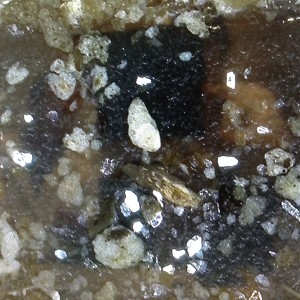
A foram found in a sample from the core taken from Loch Duart.
The species of foraminifera in the shallower samples from the core were indicative of an environment similar to that of today, where the area is inundated at the highest tides, and isolated from the sea at low tides.
Samples deeper than 154cm did not contain any forams, suggesting the presence of fresh water at time this sediment was deposited, as forams only exist in marine or brackish waters. However, based on the Troels-Smith classification of the sediment earlier, we would not expect a fresh water environment until a depth of 188cm in the core. It may be that the absence of forams in the sample was due to the calcareous foraminifera being dissolved by acidic pore water, as in some of the shallower samples, there were several partially dissolved forams.